
Overview of the successful closure of GREENLand
The project GREENLand – TWINNING MICROPLASTIC-FREE ENVIRONMENT is now officially closed. We are grateful for the opportunity to collaborate as partners in the development and implementation of an innovative strategy for transforming to a digital Cloud-Based System with the education of staff for research of microplastics in soil, water, and microorganisms, as well as networking with the excellent institutions and stakeholders who are interested in the results of scientific research.
The essence of GREENLand was to change the system in which a great contribution will be made to the planet without plastic by working on preventive measures, innovations, and a plan for remediation. Trained professional staff are able to be more efficient with the help of new digital tools, which resulted in the establishment of strong cooperation with institutions and industry.
The GREENLand project was founded by the European Union under the Horizon Europe Widening Participation and Spreading Excellence Programme. The project was a 1.5 million Euro, three-year Twinning project with partners from two EC member states and one associated country: University Educons, as project coordinator (Serbia), Alfred Wegener Institute, Helmholtz Centre for Polar and Marine Research (Germany) and University of Galway (Ireland).
Final Technical Review Meeting
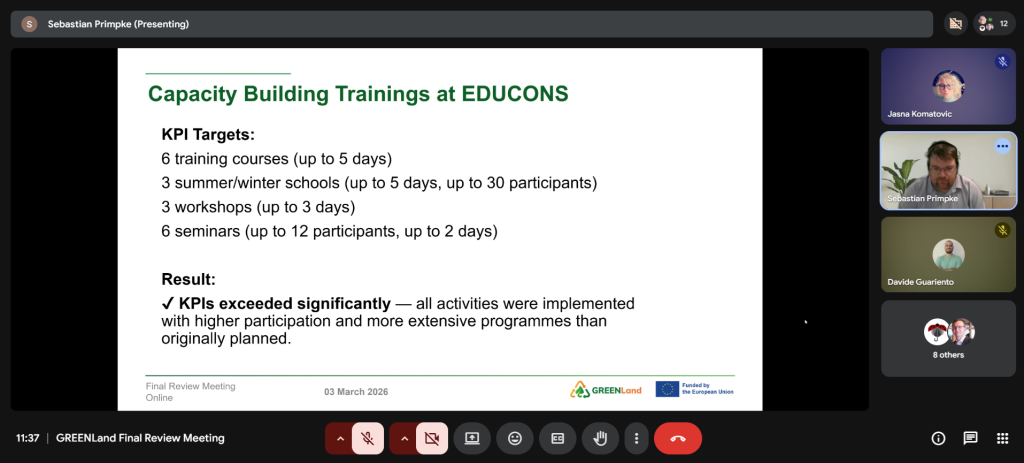
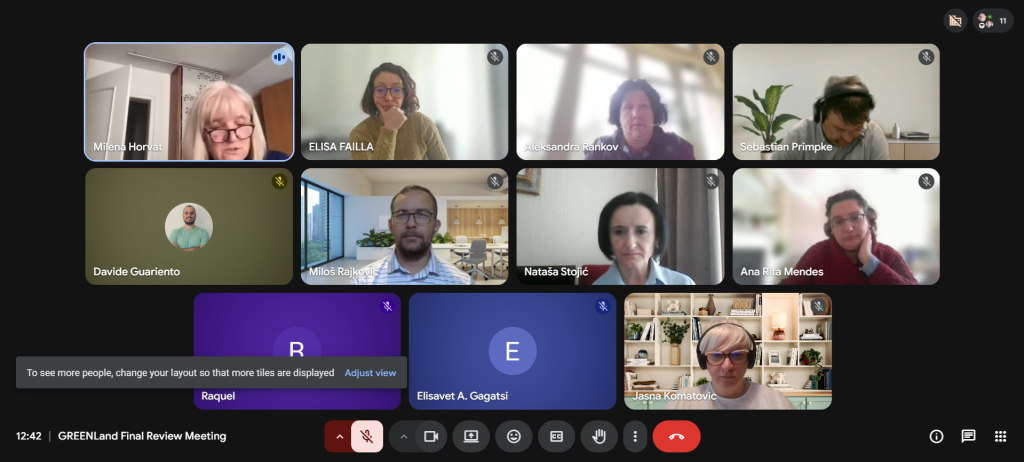
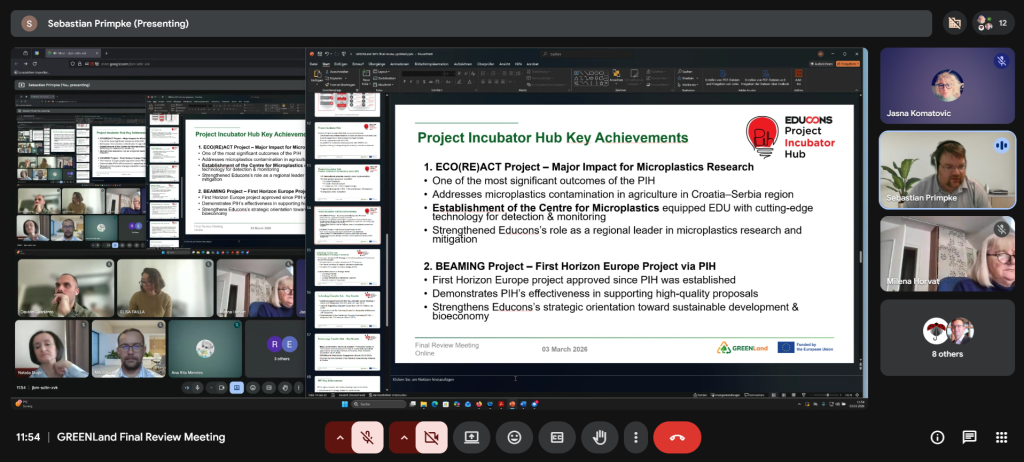
GREENLand has passed another major milestone in project completion: the Final Technical Review Meeting. The project held its final review meeting on March 3rd, 2026, online. During the meeting, the consortium partners showcased their work on the project, while the Project Officer and the Reviewer praised the project’s development, outputs, exploitations and objectives.
Following the presentations, the feedback from the PO and the Reviewer was highly positive assessments. It was a successful voyage that was accomplished in the best possible manner due to all the project’s partners.
The CORDIS platform’s “Results” section provides an in-depth overview of the whole development process and outcomes of the GREENLand Project.
By increasing knowledge and the use of technologies on prevention, detection, and purification of microplastics, this project contributed to the safety of food and the environment. Furthermore, the project activities strongly encouraged and fostered the development of researchers in the region, united in their quest to protect the environment.
GREENLand will benefit EU citizens and beyond because the baseline of the project was the creation of a microplastics-free environment and food for the future, with the objective to reach zero-microplastics pollution and zero-hunger goals in an eco-friendly environment. What a journey for us! We express our gratitude to the partners and all participants of this project for their collaboration and anticipate further opportunities and activities aimed at creating a microplastic-free environment.